
 Start here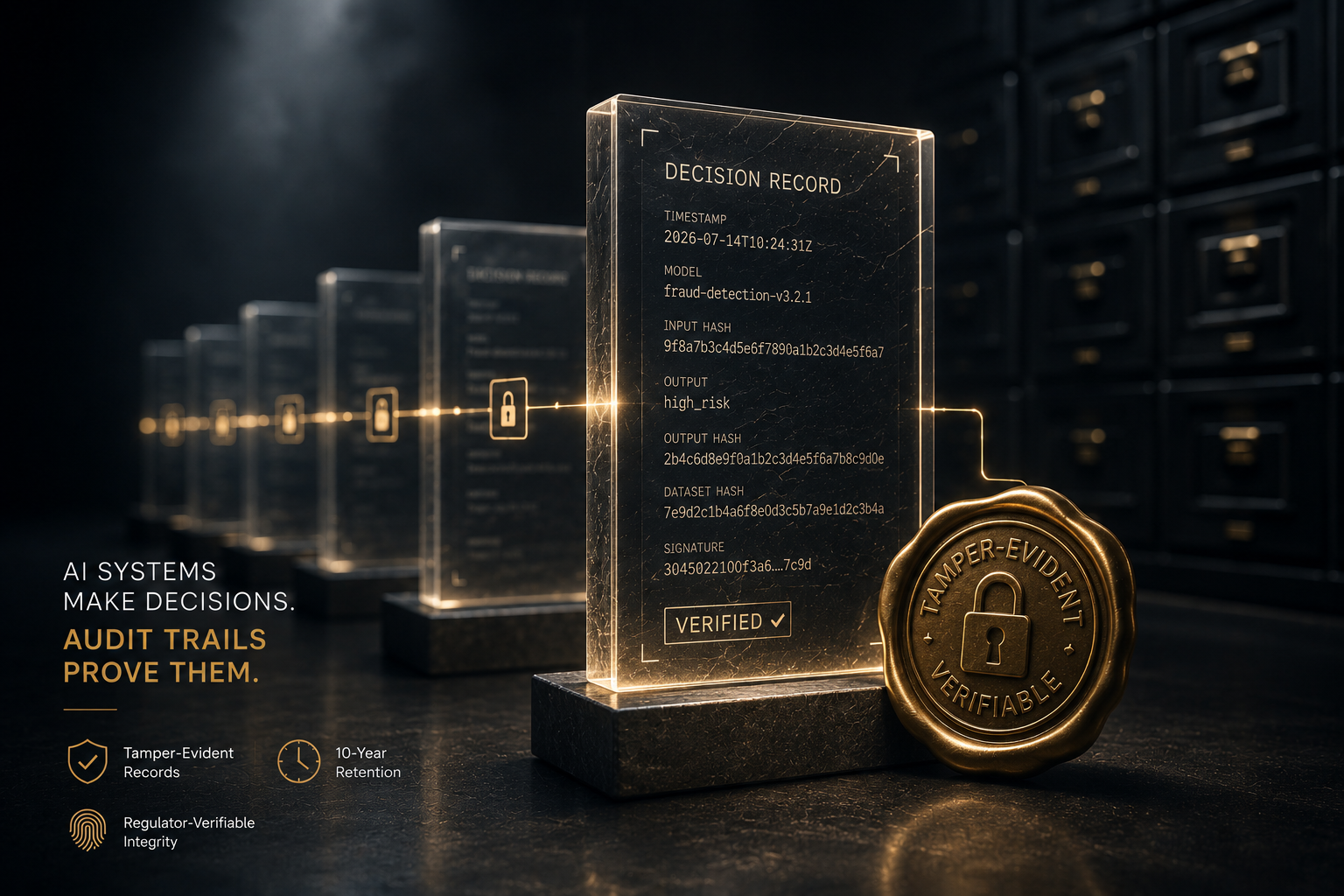
AI Observability vs AI Audit: What's the Difference?
AI observability monitors model behavior in real time. AI audit produces durable, verifiable evidence of past behavior. They answer different questions, use different storage substrates, and serve different buyers; most regulated AI programs need both.
The short answer
AI observability is the practice of monitoring an AI system's behavior in real time: latency, accuracy, drift, bias, hallucination rate, token usage, cost. It tells you what your model is doing right now and helps your ML team fix it before users notice.
AI audit is the practice of producing durable, verifiable evidence of what an AI system did, on what data, with what model version, at a specific point in time. It tells a regulator, an auditor, or a court what your model did a year ago, and proves the record hasn't been altered since.
The two disciplines are often confused because both involve "logging what the AI does." They are not the same. Observability lives in a mutable database optimised for fast queries and dashboards. Audit lives on a tamper-evident substrate optimised for evidentiary weight. Most regulated AI programs need both, deployed side by side.
AI observability vs AI audit at a glance
| Dimension | AI Observability | AI Audit |
|---|---|---|
| Primary question answered | "Is my AI behaving correctly right now?" | "Can I prove what my AI did then?" |
| Time horizon | Real-time and near-term (seconds to weeks) | Historical evidence (months to years, regulator-defined) |
| Storage substrate | Mutable database / time-series store / log warehouse | Tamper-evident record (cryptographic hash chain, append-only ledger, or permanent storage) |
| What's recorded | Metrics, traces, prompts, completions, drift signals, latency, cost | Model fingerprints, dataset fingerprints, input/output hashes, decision provenance, timestamps |
| Editability | Logs can be edited, rotated, dropped, re-ingested | Records cannot be silently altered without detection |
| Regulator / auditor usability | Useful for investigations but not independently verifiable | Independently verifiable evidence; an auditor can check integrity without relying on a hosted dashboard |
| Typical buyer | ML platform team, MLOps lead, head of data science | Chief compliance officer, risk officer, internal audit, legal |
| Frameworks it maps to | SRE / observability practice, ML monitoring | EU AI Act technical documentation, NIST AI RMF (particularly Measure and Manage), ISO/IEC 42001, internal audit |
| Example vendors | Fiddler AI, Arthur AI, Arize AI, Latitude, Helicone, LangSmith | Credo AI, Holistic AI, Monitaur |
The vendor list is illustrative, not exhaustive, and some products span both categories at the edges. Fiddler AI and Arthur AI, in particular, market governance and compliance features alongside their observability cores; both companies sell governance-adjacent tooling and self-describe as platforms rather than pure monitoring. The category split here is based on the substrate the product is built on, not the marketing surface area: a mutable database optimised for queries versus a tamper-evident store optimised for evidentiary weight. A vendor with a governance UI on top of a mutable database still has the substrate of an observability product.
How AI observability works
AI observability is borrowed almost line-for-line from software observability (the same discipline that brought us Datadog, New Relic, and OpenTelemetry) and adapted for the statistical, non-deterministic behaviour of machine learning models.
A typical observability stack works like this:
- Instrumentation. The model serving layer is wrapped with a client or SDK that captures every inference: the prompt, the completion, the model version, the input features, the prediction, the confidence score, the latency, the cost.
- Ingestion. Those events are streamed to a managed backend, usually a time-series database or a columnar store optimised for high-cardinality analytical queries.
- Metrics and traces. The backend computes aggregate metrics: hallucination rate by prompt template, drift between this week's input distribution and last quarter's training data, output quality scores, group fairness metrics.
- Dashboards and alerts. Engineers watch live charts. When drift or accuracy crosses a threshold, the system pages the on-call ML engineer.
- Iteration. The team retrains, rolls back a model version, tweaks a prompt, or adjusts a guardrail, and watches the dashboard return to green.
This is the bread and butter of vendors like Fiddler AI, Arthur AI, and Arize. They are mature products positioned around explainability, drift detection, bias monitoring, and model performance management. For the question they answer (is my AI behaving correctly right now?) they are excellent.
The data they produce sits in a mutable store. That is the right design choice for observability. Time-series databases are tuned for fast aggregate reads; allowing edits, retention rotation, and re-ingestion is what makes them performant and affordable. Nobody would build a real-time dashboard on top of a tamper-evident ledger.
How AI audit works
AI audit answers a different question, and the storage substrate has to match.
A regulator, an external auditor, or a court asking "what did your high-risk AI system do on July 14, 2026?" is not asking for a Grafana screenshot. They are asking for evidence: a record that meets three conditions.
- Existed at the time of the decision. Not reconstructed after the fact.
- Has not been altered since. Or, if it has, the alteration is visible.
- Can be verified independently. The auditor does not have to take the vendor's word for it.
That set of requirements is incompatible with a mutable database. Logs you can edit are not evidence; they're a story you can write. Auditors and regulators have understood this for decades, which is why financial audit, clinical-trial audit, and forensic audit all use append-only or tamper-evident records.
A typical AI audit stack works like this:
- Capture. At the moment of training, deployment, or inference, the system computes a cryptographic fingerprint (a hash) of the relevant artefact: the training dataset, the model weights, the input, the output, the decision rationale.
- Anchor. That fingerprint is written to a tamper-evident substrate: a hash chain, an append-only ledger, a permanent storage network, or a notary service. Only the fingerprint needs to be anchored, so a team can keep the underlying data in its own environment.
- Preserve. The record is retained for the duration the relevant regulation requires (EU AI Act technical documentation, for example, must be available to authorities for ten years after the system is placed on the market).
- Verify. Years later, an auditor recomputes the fingerprint from the artefact, compares it to the anchored record, and gets a yes/no answer on whether the artefact is unchanged. No trust in the vendor required, just trust in the cryptography.
- Report. The audit system produces a regulator-presentable bundle: the artefact list, the fingerprints, the timestamps, the chain of custody.
Vendors in this category differ in how they implement the substrate. Credo AI and Holistic AI lean toward governance workflows on top of conventional databases plus signed records. Monitaur is positioned around model governance and audit-trail SaaS.
ar.io is protocol infrastructure rather than an AI audit workflow product. AI teams can use it to publish fingerprints or artifacts as permanent records, keep them available through gateway caches, and verify retrieved data against the permanent source.
The point isn't that one substrate is the only correct answer. The point is that audit-grade evidence has a tamper-evidence requirement that observability tools, by design, do not meet.
Why a mutable database log is fine for observability but problematic for audit
Observability logs are operationally trustworthy. The team running them is not going to silently rewrite history; in most organisations, doing so would be a serious internal incident. For day-to-day engineering use (debugging, drift detection, performance tuning) a mutable log is exactly the right tool.
The problem is not whether the log was edited. The problem is whether you can prove it wasn't to someone who has no reason to trust you. A regulator investigating a high-risk AI incident, an external auditor running a conformity assessment, or opposing counsel in litigation will not accept "trust us, we didn't touch it" as a control. They will ask for the same kind of evidence financial auditors have asked for since SOX: an unbroken, tamper-evident chain of custody.
A mutable observability database cannot produce that. Not because the vendor is untrustworthy, but because the design of the storage substrate makes silent editing possible and undetectable. The control is missing.
This is why mature AI governance programmes treat observability and audit as two layers in the same stack, not as substitutes.
Where the categories will and won't converge
Some observability vendors are adding "audit logs" to their feature lists. Some audit-trail vendors are adding live monitoring dashboards. Buyers should look past the labels and ask three questions:
- Where does the record live? If it lives in a database the vendor can edit, it is observability with extra metadata, not audit.
- Can the auditor verify integrity without trusting the vendor? If verification requires the vendor's cooperation or hosted dashboard, it isn't self-authenticating.
- What is the substrate's expected lifetime? EU AI Act technical documentation requires ten-year retention. Observability stores are typically tuned for 30–90 days of hot data.
When all three answers point to an integrity-anchored, externally verifiable, long-lived record, you are in the audit category. When they don't, you are in observability.
FAQs
Do I need both AI observability and AI audit?
For most regulated AI deployments (high-risk systems under the EU AI Act, AI in financial services, AI in healthcare, AI in employment decisions) yes. Observability keeps the system performing correctly day to day. Audit produces the evidence you'll need to show a regulator, internal audit, or a court. The two systems answer different questions and are usually deployed together, often by different teams in the same organisation.
Which one does the EU AI Act require?
The EU AI Act doesn't use the words "observability" or "audit" directly, but the obligations it places on high-risk AI systems map cleanly onto the audit category. Article 12 requires automatic logging of events over the lifetime of the system (with a minimum six-month retention on those event logs under Article 26(6) for deployers). Article 11 and Annex IV require technical documentation that can be made available to authorities. Article 18 requires the technical documentation and related conformity records to be kept available to authorities for ten years after the system is placed on the market or put into service. Together these obligations describe a tamper-evident, long-lived, regulator-presentable record: the audit pattern. High-risk system enforcement was originally scheduled for 2026-08-02, though the EU's Digital Omnibus on AI provisional agreement reached on 2026-05-07 would defer application for new or substantially modified Annex III high-risk systems to 2027-12-02, still subject to formal adoption.
Can my AI observability tool give me audit-ready records?
It depends on the storage substrate, not the marketing label. If the records live in a database that can be edited, rotated, or dropped, they are not audit-grade. If the vendor anchors record hashes to a tamper-evident store (a hash chain, a permanent storage network, a notary service) and can demonstrate an independent verification path, then those specific records may meet audit requirements. But the rest of the observability log is still observability. Ask the vendor for the integrity-control documentation, not the feature comparison.
What is C2PA and how does it relate to AI audit?
C2PA, the Coalition for Content Provenance and Authenticity, is an open standard for attaching tamper-evident provenance to digital content. It was co-founded in 2021 by Adobe, Arm, BBC, Intel, Microsoft, and Truepic; the steering committee has since expanded to include OpenAI (May 2024), Google, Meta, Amazon, Sony, Publicis Groupe, and others. C2PA defines how to bind a cryptographic signature to an image, video, document, or AI output so downstream systems can verify where it came from and whether it's been altered. C2PA produces signed, verifiable artifacts that an evidence-retention system can preserve. Permanent records can keep those credentials retrievable after the original platform or verification service changes.
How can ar.io support an AI evidence workflow?
AI teams can use ar.io to preserve dataset versions, model artifacts, inference records, or cryptographic fingerprints on permanent storage. Independent gateways can cache, retrieve, and verify those records against the permanent source. This can support an evidence-retention workflow, but ar.io is not an observability platform or a compliance product, and permanent records alone do not establish compliance.
What's the difference between mutable database logs and cryptographic audit trails?
A mutable database log is a record stored in a system where authorised users can edit, delete, or overwrite entries. It is fast, queryable, and operationally useful, but its integrity depends on the operator's good behaviour, which is not a control a regulator can verify. A cryptographic audit trail records a hash (a one-way fingerprint) of each artefact to a substrate where prior entries cannot be silently changed: an append-only ledger, a hash chain, a permanent storage network. Anyone with the artefact can recompute the hash and compare it to the anchored record. If they match, the artefact is unchanged; if they don't, the change is detectable. That externally verifiable integrity is what makes a record audit-grade rather than merely operational.
What is an AI audit and why does it matter?
An AI audit is a structured examination of an AI system (its data, its models, its decisions, and its controls) designed to produce evidence that the system meets a specific standard, whether that's the EU AI Act, NIST AI RMF, ISO/IEC 42001, an internal risk policy, or a contractual obligation. It matters because AI systems are increasingly making consequential decisions (hiring, lending, medical triage, content moderation) in environments where regulators, customers, and courts will eventually ask: prove it. Without a tamper-evident audit trail captured at the time of the decision, "prove it" becomes a story rather than evidence. The audit trail is the artefact that converts AI governance from a policy document into a defensible position.