
 Get Started
Receipts That Last: Why Provenance MUST Outlive the Systems That Create It
Why durable AI provenance matters, and why receipts must live in tamper-resistant, independent infrastructure that outlasts the platforms that create content.
With AI-generated outputs gaining real economic weight, disputes over origin, intent, and integrity become inevitable. Verifiable receipts, tamper-resistant records proving how that value was produced, are the only reliable way to reconstruct truth when challenged.
Most receipts today live inside the same platforms that generate the outputs, inheriting those platforms' finite lifecycles. When systems evolve, migrate data, undergo API changes, or switch vendors, the evidence often vanishes. This fragility matters far more than it first appears.
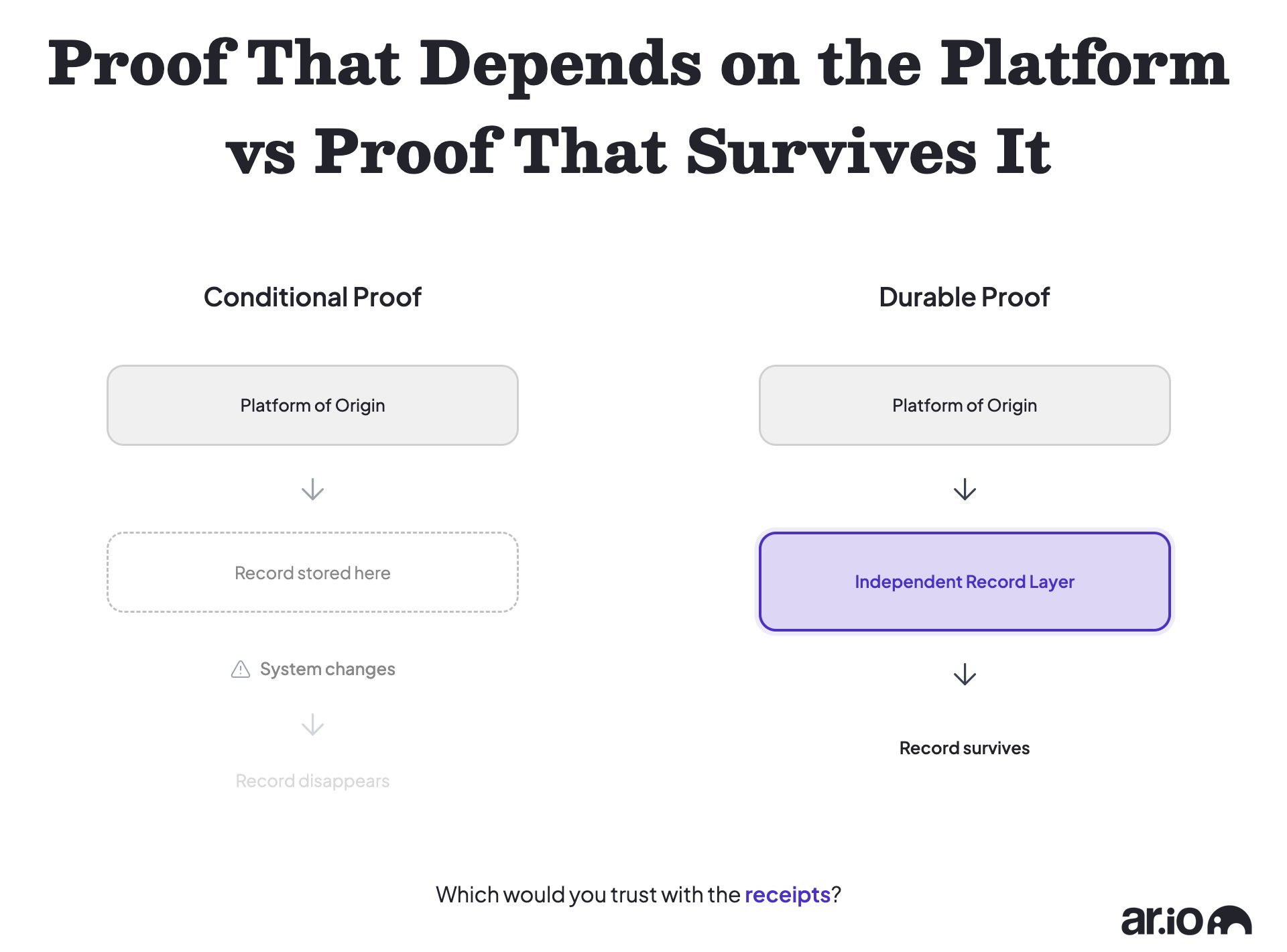
Regulators now pose one direct question: Can you prove what the system actually did? In banking, AI agent developers chain logs to resist tampering, but those logs remain brittle if tied to the executing platform. In media, the C2PA standard embeds cryptographically signed metadata to track origin and edits. Yet major social platforms routinely strip or discard such embedded credentials during upload and distribution. Industry observations show this happens almost universally, forcing reliance on external lookup services that introduce new points of failure.
Without durable provenance, ownership disputes escalate, licensing agreements become difficult to enforce, and compliance with training-data restrictions erodes. Regulators, insurers, and internal investigators need historical evidence to assess decisions, not post-hoc explanations. A significant share of breach investigation and containment costs stems from the absence of verifiable records. Per IBM's 2025 Cost of a Data Breach Report, the global average breach cost stands at $4.44 million (down 9% from 2024 due to faster AI-assisted detection), while U.S. costs hit a record $10.22 million, much of it tied to prolonged forensics without hard evidence.
True defensibility requires receipts with four core traits:
- Persistence: receipts must outlast the platform that created them.
- Neutrality: verification cannot depend on the generator itself, avoiding circular trust.
- Tamper resistance: cryptography must preserve integrity over time, not just internal assurances.
- Survivability: receipts must remain intact through migrations, restructurings, and vendor changes.
When receipts embody these properties, they stop being mere logs and become essential infrastructure. Arweave's permanent storage model delivers exactly this through its pay-once, store-forever endowment, cryptographic immutability, and decentralized gateway access.
The shift is already visible. Governance programs increasingly recognize that operational logs were never designed for long-term auditability. 72% of S&P 500 companies now disclose AI as a material risk in public filings, up sharply from 12% in 2023, yet many still lack mature programs (Conference Board/ESGAUGE, 2025). Regulated sectors like finance have long required records that outlive the systems producing them. Investor confidence and compliance depend on it. AI systems face the same imperative.
Regulatory pressure is mounting. The EU AI Act's Article 50 transparency obligations, requiring machine-readable marking of AI-generated content, become fully enforceable on August 2, 2026, with penalties reaching €15 million or 3% of global annual turnover for violations.
Most organizations still default to conditional, platform-tied receipts. When scrutiny arrives and records are demanded, is that position defensible?
The organizations that act early, building or adopting independent, permanent provenance layers, will prove AI value creation long after original tools and platforms have changed. Solutions like ar.io, which anchor authenticity records (including C2PA manifests, hashes, and soft-binding indexes) in immutable infrastructure, represent one promising approach to making receipts truly durable and verifiable over decades. The permaweb further enables this by supporting verifiable AI through permanent, cryptographically timestamped datasets and transparent provenance.
In an era where AI makes outputs cheap and proof expensive, the real competitive edge belongs to those who ensure their provenance lasts on a credibly neutral system.